
Fiscal Aging Using Account Report
Fiscal Aging Using Account Report
Fiscal Aging Using Account Report
Module: Accounting
Overview
Use the Fiscal Aging Using Account report to list account balances by:
Aging date
Revenue type
You may run this report for either the current fiscal period or a previous fiscal period.
Note: This report will not work when option bl196 is off. When bl196 is off, SBN does not update fiscal control tables when a fiscal period is closed.
To access this report, select Fiscal Aging Using Account (report #2116) from the main menu of SBN.
The Fiscal Aging Using Account Report
This window contains two panes: use the upper pane to define the contents of the report; use the lower pane to define the job output - how, when, and where you want the report printed.
Note: See Report Parameters Pane for information on the fields in the lower pane, which are the same in every report.
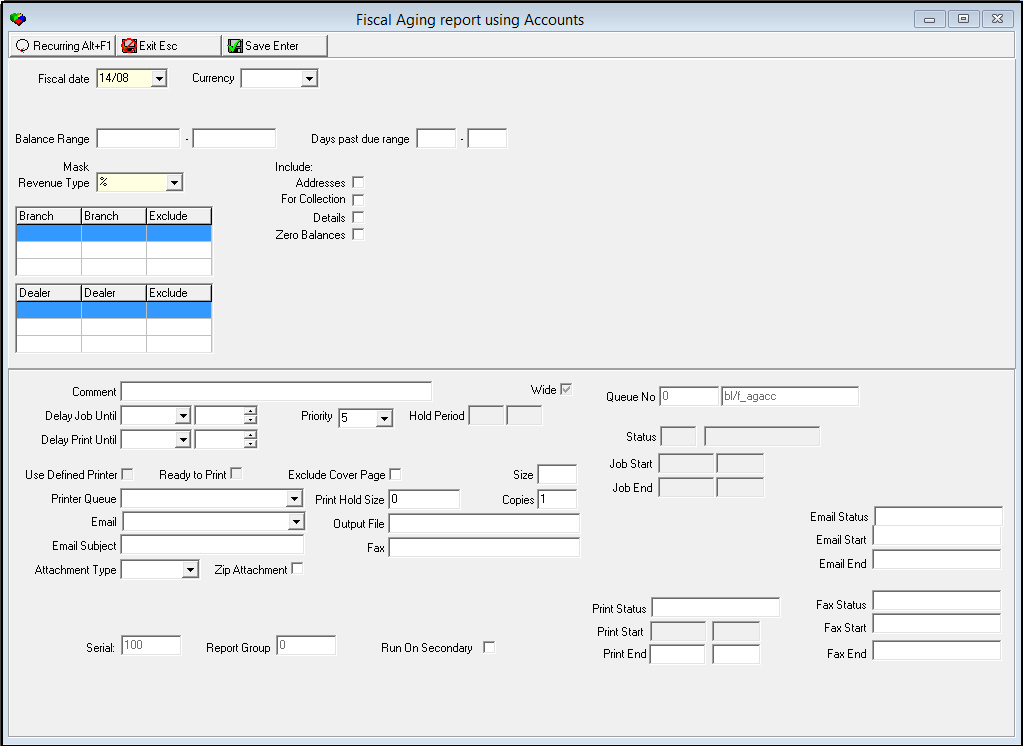
Field Descriptions
The following table describes the fields used in the upper pane of this report.
You can use wildcard characters in selected fields. For more information on using wildcards, see Searches.
Field |
Wildcards Accepted |
Description |
Fiscal Date |
No |
You must select a fiscal date. Select the first day of the month on which you want to report. O The report calculates the difference between the selected date and the invoice transaction date (or the invoice due date) to determine the age group in which to place an amount for the selected fiscal period. O Option bl001 defines whether the aging balances are based on invoice due date or invoice transaction date. |
Balance Range |
||
Balance
minimum |
No |
You may type a range of balances to limit the report to account balances within that range. Type the minimum balance of the range. O If you leave this field blank, the report defaults to $0.01. |
Balance maximum |
No |
You may type a range of balances to limit the report to account balances within that range. Type the maximum account balance of the range. O If you leave this field blank, the report defaults to $21,474,836.47. |
Days Past Due Range |
||
Minimum
Days Past Due |
No |
You may type a range of days past due to limit the report to accounts past due within that range. Type the minimum number of days past due of the range. O If you leave this field blank, the report defaults to -32767 days. O If the days past due range includes 0 and the revenue type is %, the report includes credit balances. |
Maximum
Days Past Due |
No |
You may type a range of days past due to limit the report to accounts past due within that range. Type the maximum number of days past due of the range. O If you leave this field blank, the report defaults to -32767 days. O If the days past due range includes 0 and the revenue type is %, the report includes credit balances. |
Revenue Type |
Yes |
You must either select a revenue type to limit the report to accounts with that revenue type or use the % wildcard to include all revenue types. (This menu originates from program #1512.) O If the days past due range includes 0 and the revenue type is %, the report includes credit balances. |
Include |
||
Addresses |
No |
Enter a check mark in this box to include the account address in the report. O If you enter a check mark in this box, you must also enter a check mark in the Details field. |
For Collection |
No |
Enter a check mark in this box to use this report as a collection report. O If you enter a check mark in this box, the report l Excludes accounts with aged amounts greater than the maximum balance you select as a report parameter l Excludes accounts with amounts (credit or debit) aged more than the maximum number of days past due that you select as a report parameter. O If you leave this field blank, the report may include accounts with an aged balance greater than the maximum balance you select as a report parameter. |
Details |
No |
Enter a check mark in this box to include account details in the report. |
Zero Balances |
No |
Enter a check mark in this box to include accounts with zero balances. |
Branch Ranges |
||
Branch |
No |
You may select up to three ranges of branches to limit the report to branches within the ranges. Select the beginning branch number of a range. (These menus originate from program #1530.) O If you leave the fields blank, the report includes all branches in your user profile. O Branch restrictions apply. |
Branch |
No |
You may select up to three ranges of branches to limit the report to branches within the ranges. Select the ending branch number of a range. (These menus originate from program #1530.) O If you leave the fields blank, the report includes all branches in your user profile. O Branch restrictions apply. |
Exclude |
No |
You may exclude ranges of branches from the report by selecting the ranges and then entering a check mark in the corresponding Exclude box. |
Dealer Ranges |
||
Dealer |
No |
You may select up to three ranges of dealer to limit the report to dealers within the ranges. Select the beginning dealer ID of a range. (These menus originate from program #1540.)
Note: A dealer restriction exists whereby the dealer listed within the billing accounts must match the dealer listed in the dealer table. |
Dealer |
No |
You may select up to three ranges of dealer to limit the report to dealer within the ranges. Select the beginning dealer ID of a range. (These menus originate from program #1540.)
|
Exclude |
You may exclude ranges of dealer from the report by selecting the ranges and then entering a check mark in the corresponding Exclude box. |
|
Running and Viewing a Report
For information on running and viewing a report, see Common Functions in SBN.
Report Example
The following graphic shows an example of the output of the Fiscal Aging Using Account Report.
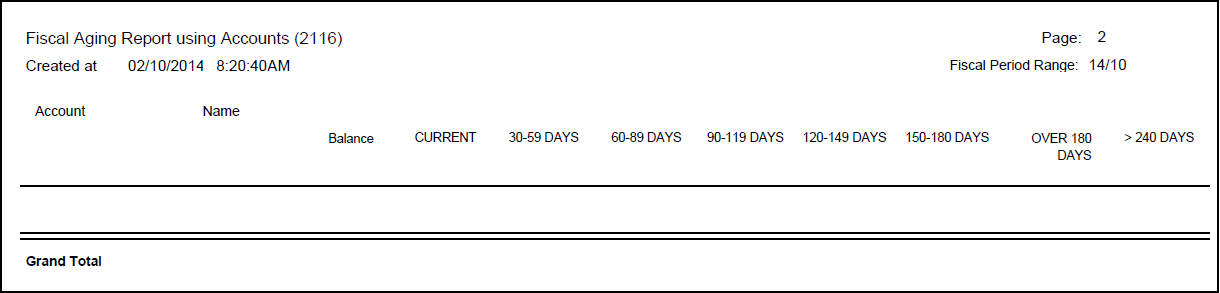
Note: The Fiscal Period Range field appears at the top of the report.
Column Descriptions
The following table describes the columns used in the output of the report.
Column |
Description |
Account |
Account number. |
Name |
Account name. |
Balance |
Open balance on the account. SBN looks at l Open invoices l Open credits l Open balances l Write-offs l Payments |
Dynamic Labels |
Open balance for each of the company-defined aging categories. O Because of the width limitations of this report, the final column includes all of the age levels beyond the fifth company-defined aging category. |
(No label) |
If you selected Include Addresses as a report parameter, this line contains the following information for the account: l Street address l City l Zip code l State l Phone |
Grand Total |
Totals in each column for all accounts included in the report. |
Button Functions
The following table displays the buttons, describes the shortcut keys, actions, and functionality.
Button |
Name |
Shortcut Key |
Action |
Description |
|
Open fields for recurring/template reports |
alt+f1 |
Open fields for recurring/template reports. |
|
|
Exit without saving |
esc |
Exit without saving changes to selected record. |
|
|
Save Existing Record |
enter |
Save changes to selected record. |



Modifications and Updates to Fiscal Aging Using Account Report
The following table lists modifications and updates to the Fiscal Aging Using Account Report document.
Mod Number |
Date |
Description |
n/a |
8/04/14 |
Images updated. |